Pages

Showing posts with label making waves. Show all posts

Tuesday, 17 November 2020

Electricity Circuit


Series Circuit: which bulb is in one continues line.


Parallel Circuit: A circuit in which the bulb is divided up evenly. 

This week we will be learning how to build simple circuits and also how to correctly draw them


Notes:


Link to Quizlet terms: https://quizlet.com/_7x5s06?x=1jqt&i=2lxqn1 


Activity: 

Go on to the PHET website and click on LAB: https://phet.colorado.edu/sims/html/circuit-construction-kit-dc/latest/circuit-construction-kit-dc_en.html

I want you to construct a few different circuits, try to make them and then take a screenshot of them and post the pic here.


  1. A circuit containing a battery, a light bulb, connected by wires:


  1. Now add a switch into the circuit you just made, what happens when the switch is open or closed?


  1. Now click on the battery and increase the voltage it supplies to the circuit. What happened?


  1. Underneath the switch there is an arrow, scroll through the options to the end and try putting some random things into the circuit like a coin or dog. What happens to light bulbs? It lights a lot and the full energy of the batteries


Experiment:

We will actually build circuits when you come back!


Wednesday, 11 November 2020

Speed of light


300,000,000 M/S
0.006 Sec


Investigating the laws of reflection

Equiptment: 
  • Mirror 
  • Light box
  • Power supply

Aim: To investigate how light behaves when it hits a plane (flat) mirror.

Method: 

1. Collect a ray box, power supply and single-slit ray side from your teacher, and set them up to produce a single beam of light.

2. Place a plane mirror on the diagram of the protractor as described below.
3. Vary the angle of incidence and record the angle of reflection in the result table.


Result

Angle of Incidence 

Angle of Reflection

                                  0°

10°

20°

20°

30°

30°

40°

40°

50°

50°

60°

60°

70°

70°

70°

80°

80°


Wednesday, 4 November 2020

Electricity


Static Electricity
A build-up of electrical charges on an object

Current Electricity
A flow of electric charge.

Electrical Charge
electrical particles that are negatively charged

Circuit
A system that provides a pathway for electrical current to flow through

Cell
Supplies energy to a circuit, by pushing current from the positive to the negative end

Voltmeter
A device used to measure voltage, or electrical potential energy difference

Ammeter
A device used to measure current in a circuit

Wire
a thin, flexible thread of metal

Resistor
An electrical device that resists the flow of electrical current

Bulb
In a circuit, this shows if electricity is flowing by lighting up

Switch
a device that opens or closes a circuit

Battery
A device that converts chemical energy to electrical energy


1- Fill in the table


Static electricity

Current electricity

What is it caused by?

The imbalance between negative and positive charges in an objectAn atom usually has the same number of protons  (which have a positive charge) and electrons (which have a negative charge)

Do the negative charges move?

Negative charges can move freely from one object to anotherAn electric circuit is caused by the movement of the charges through the conductors of the circuit.

Does it power appliances?

Electricity usage monitor that tells you exactly how many kWh a device or appliance is drawing.If the electricity provided is desired to do work, the load/appliance can be placed at the middle of the electric circuit


2- What are some examples of static electricity:

  1. If you rub your shoe on the carpet, your body collects extra electrons

  2. When you touch the playground your body get static electricity.

  3. Walking across the carpet and touching a metal door handle and pulling your hat off and having your hair stand on end.

  4. When you jump on the trampoline get electricity static.


Write up for a Van der Graaff experiment:


How does the Van der Graaff machine work?

A Van de Graaff generator pulls electrons from the Earth, moves them along a belt and stores them on the large sphere. These electrons repel each other and try to get as far away from each other as possible, spreading out on the surface of the sphere.


What was one of the experiments they did with the machine?

Is when they hold there hands on the machine and the machine is turning on and the static is all in there body.


Describe what happened, what did you see?

I see when my friend standing there holding the machine and the static was all in there body and their hair was standing up because of the electricity coming on their body.


Why did you see this happen?

Because my friend wanna try it and There hair went up because of the electricity going in there body and the static. I saw the teacher holding the small machine ball and he touches it to the big machine and it static and there is like a static light and the sound is loud.


Explain how lightning happens linking  to the ideas of static electricity


Often lightning occurs between clouds or inside a cloud. As the storm moves over the ground, the strong negative charge in the cloud attracts positive charges in the ground. These positives charges move up into the tallest objects like trees, telephone poles and houses.

What does it feel like to be struck by lightning? | The Spinoff

Tuesday, 3 November 2020

The Eye- Conclusion

 The Eye


Section 1: Label the diagram of the eye.


  1.  Sclera

  2. Lens
  3. Iris
  4. Cornea
  5. Pupil
  6. Retina
  7. Optic nerve


Quizlet: The Eye


Section 2: Complete the optical illusions and write down how you think each optical illusion works.


Optical Illusions


  1. Young

  2.  Yes

  3.  Both of them

  4.   Two faces

  5.   I can't see anything

  6.    Triangle/Rectangle3 blocks

  7.  5 line/colour black and white

  8.   Arrow/Line/Stick line

  9.  Stairs/5 blocks/Rectangle

  10.  Square/ 42 blocks/line

  11.  Square/ 2 blocks/

  12.  Rectangle/Triangle/Circle

  13.  Circle/Eye/ Line circle

  14.  Circle/Square

Section 3: Find 10 interesting facts about the eye.

  1. In a very basic form, the eye is thought to have first developed in animals around 550 million years ago!
  2. In a single second, it's possible to blink five times.
  3. You are likely to blink more often when you are talking.
  4. A block typically lasts 100-150 milliseconds.
  5. You see things upside down- it is your brain which turns the image the right way up.
  6. You actually see with your brain, not your eyes, Our eyes function like a camera, capturing light and sending data back to the brain.
  7. The human eye can function at 100% at any given moment, without needing to rest.
  8. Red-eye in photos is caused by light from the flash bouncing off the capillaries in your eyes.
  9. If the human eye was a digital camera, It would have 576 megapixels.
  10. The eye is the fastest muscle in your body- hence why when something happens quickly, we say 'in the block if an eye!'


Interesting Facts

Section 4: Colour Blindness Eye test


Eye Test 


  1. What are your colour blind test results? Good, Inconclusive

  2. What does this mean? It means your eyes good

  3. What is the normal colour vision?

Wednesday, 28 October 2020

Eye Dissection

 Aim: To dissect a cow's eye and look at the different parts of the eye.


Equiptment: 

1.  A Cow's eye
2.  Tray
3.  Tweezers
4.  Scissors
5.  Newspaper
6.  Gloves


Cow Eye Dissection

Method:

1. Set up a tray with newspaper on the desk, the tray on top and the scissors and tweezers in the tray.

2. Put on a rubber glove.

3. Start to remove the excess fat and meat from around the eyeball before dissecting it.

4. Puncture a hole in the corner where the cornea and the sclera meet.

5. Cut around the cornea so that the vitreous fluid leaks out of the eye onto the tray.

6. Once the cornea has been totally removed you will be able to remove the lens from the iris.

7. Cut the eye in half so that the inside is totally exposed. Once this has been done you will be able to access the retina at the back of the eye.

8. You should now have placed the retina, lens, cornea and iris on a place of paper.

9. The dissection is now completed and all parts of the eye need to be wrapped up and trashed. The trays and utensils that were needed must be rinsed and the rubber gloves throw out.


Summary:

The cow's eye has exactly the same parts as the human eye except for its ability to see better in the dark.


Cow Eye Dissection | Perkins eLearningDissection 101 | Detailed Cow Eye Dissection Video (Part 1 of 2) | PBS  LearningMedia


Wednesday, 21 October 2020

Reflection and Refraction

Definition


Reflection
The bouncing back of a wave when it hits a surface through which it cannot pass.

Refraction
The bending of a wave as it passes at an angle from one medium to another

Incident ray
Incoming ray

Reflected Ray
the light ray that bounces off a surface

Refracted Ray
The Ray that has bent as it enters a new medium

Normal line
An imaginary line is drawn perpendicular to the surface of a mirror or any surface

Angle
The amount of bending that a light ray experiences 

Complete the sentences using the following keywords:

Reflection   light   reflected    normal   same    incidence


When Lights hits a mirror, the angle at which it hits is the Incidence as the angle at which it is Reflected. Scientists called this the Law of Reflection. Incorrect science terms, the Reflection Law states that the angle of Normal is equal to the angle of Same when measured from the Reflection.


Diagram


Research Task:

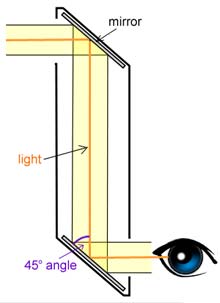
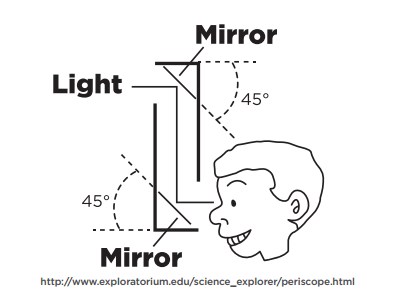
  1. What is a periscope? Is an optical instrument that uses a system of prisms, Lenses or mirrors to reflect images through a tube. 
  2. How does it work? Light from a distant object strikes the top mirror and is then reflected at an angle of 90 degrees down the periscope tube.
  3. Draw and label a periscope?
    Science Club - PeriscopesPeriscopes - Science World